 Skip to content
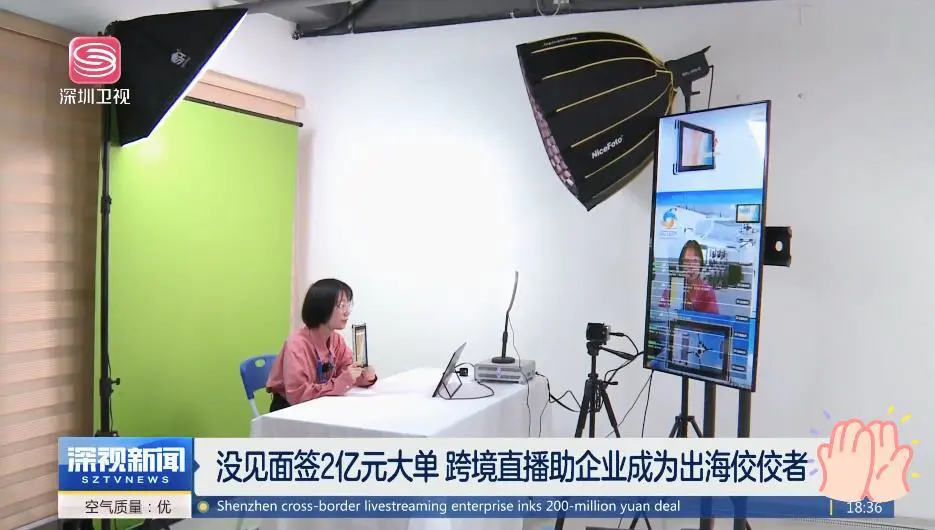
A standard office desk, a Bihuo Smart live streaming device, and an English-fluent "cross-border host"—this simple setup forms the scene of a live streaming session targeting global customers. In no time, the live stream attracts Peter, a client from the U.S., who directly expresses his purchase intent in the live chat, leading to a successful cross-border online transaction in this compact studio.

Amid the ongoing complexity and challenges of the global economy and foreign trade environment, enterprises are leveraging cutting-edge technologies and innovative sales methods to pioneer a new path for high-quality "going global" of Made-in-China products.
Recently, Shenzhen Suoteng Technology Co., Ltd. successfully secured a 200-million-yuan overseas order through cross-border live streaming. After years of exploration and development, the company has transformed from a small shop in Huaqiangbei into a Shenzhen "specialized, refined, distinctive, and innovative" (SRDI) high-tech enterprise.
The Bihuo Smart live streaming device, developed by Suoteng Technology, utilizes independently developed software and hardware innovation to enable the creation of rich virtual studio scenes, helping cross-border businesses "go global" and tap into international markets.
The Bihuo Smart live streaming device primarily consists of a live streaming box and a production control screen as its core hardware, paired with the AiDirector software. It offers a wide range of functional applications, allowing live streaming without the need for a smartphone or computer, and supports multi-camera setups and multi-device connections. Notably, its real-time remote screen-sharing feature enables overseas clients to remotely view factory production processes and live reception scenarios.

According to Alibaba data, 66% of global buyers are young individuals aged 18-40, with 75% preferring to engage with suppliers through online channels. Meanwhile, 88% of B2B buyers directly seek sourcing opportunities online.
To date, over 60,000 enterprises have conducted B2B cross-border live streaming on the platform. Qiu Zongbing, Head of Alibaba International Station’s Shenzhen Region, noted that this trend stems from overseas buyers' strong preference for efficient and cost-effective sourcing methods.
Suoteng Technology signed a contract with Alibaba in 2018 and launched its e-commerce platform the following year. By leveraging the platform, the company gained insights into end customers' actual needs and focused on developing products tailored to those demands.
Over the years, the company's most significant transformation has been expanding its customer base through the broad reach of e-commerce, while live streaming has helped bridge the gap with clients, allowing them to quickly understand the business and deepen communication and interaction. This approach has significantly boosted customer loyalty and accelerated conversions. "These are the key factors that enabled us to secure multi-million and even billion-yuan orders without meeting clients face-to-face in recent years," said Luo Chang, CEO of Shenzhen Suoteng Technology Co., Ltd.

The difference between cross-border live streaming and regular product promotion lies in the fact that cross-border live streaming targets overseas enterprise clients. Compared to follower counts, cross-border hosts prioritize fan quality. Additionally, since hosts need to engage in real-time one-on-one interactions with clients, a certain level of English proficiency is required.
Through the precise screening capabilities of cross-border e-commerce platforms, enterprises can efficiently identify potential overseas buyers, enabling transactions between buyers and sellers without physical meetings. Qiu Zongbing mentioned, "We implement a four-tier buyer classification system and a five-star seller rating system to match buyers and sellers with relatively compatible needs."
Zhang Yan, a cross-border English host, explained that cross-border live streaming does not focus on price competition but rather on quickly building rapport with clients by showcasing factory certifications and quality management practices. "The most frequently asked questions in our live streams are whether customization is possible, what the minimum order quantity is, and whether certifications are available. Hosts can instantly pull up relevant videos and materials to present them directly and intuitively to clients."

Opportunities and channels are essential, but securing orders and succeeding in international markets also require superior products and services.
After comparisons by overseas clients, the industrial tablets sold by this enterprise not only cost one-third of U.S. brands but also offer superior performance and technology, thanks to Chinese manufacturing.
"We have 13 years of experience, specializing in industrial internet and industrial smart terminals. Our in-house design, R&D, and production enable us to achieve better cost control. R&D is the lifeblood of our company, and we allocate about 20% of our resources to it annually," said Xu Tao, R&D Director of Shenzhen Suoteng Technology Co., Ltd.

From selling products in Huaqiangbei to building its own brand and developing proprietary technologies, and then venturing into foreign trade and cross-border e-commerce, this enterprise has faced multiple crises over the past decade. However, through continuous self-improvement and innovation, it has evolved into an SRDI enterprise, securing billion-yuan orders and becoming a standout success in the "going global" movement.
While rapidly acquiring customers through e-commerce, the company has also been strengthening its internal capabilities, retaining potential clients through live streaming scenarios, and repeatedly adapting to customer needs to drive conversions.
"We used to believe that producing good products would naturally lead to orders, but we didn’t fully adapt to or investigate the actual needs of end customers. In recent years, through Alibaba International Station, we have continuously improved and solidified our company’s strengths, including operations, marketing, product development, and even team organization," Luo Chang explained.

According to data from the Shenzhen Municipal Commerce Bureau, Shenzhen’s cross-border e-commerce imports and exports reached a record high in 2022, ranking first in the province and leading nationally.
Shenzhen enterprises are the absolute main force in overseas warehouse construction, operating over 250 warehouses with a total area exceeding 2.8 million square meters. Under the theme of "stabilizing foreign trade," Shenzhen has intensified its support for foreign trade enterprises through policy incentives, financial subsidies, and market optimization, serving as a "booster" for many Shenzhen SMEs to achieve high-quality development and promote Chinese manufacturing globally.

On March 17, the Shenzhen Municipal Commerce Bureau issued the Implementation Rules for Encouraging Enterprises to Participate in the Pilot Program for Transparent Cross-Border E-Commerce Retail Exports, aiming to encourage and assist enterprises in achieving compliant international expansion.
Ke Yu, Deputy Director of the E-Commerce Division of the Shenzhen Municipal Commerce Bureau, stated that the bureau will work with relevant departments to study more convenient measures for transparent enterprises and implement more substantial special support policies. "By combining a systematic policy framework with industrial collaboration, we will continue to innovate and break barriers, creating a better business environment to help more enterprises like Suoteng Technology grow and thrive."
